- This topic is empty.
-
AuthorPosts
-
22/06/2026 at 14:39 #5665
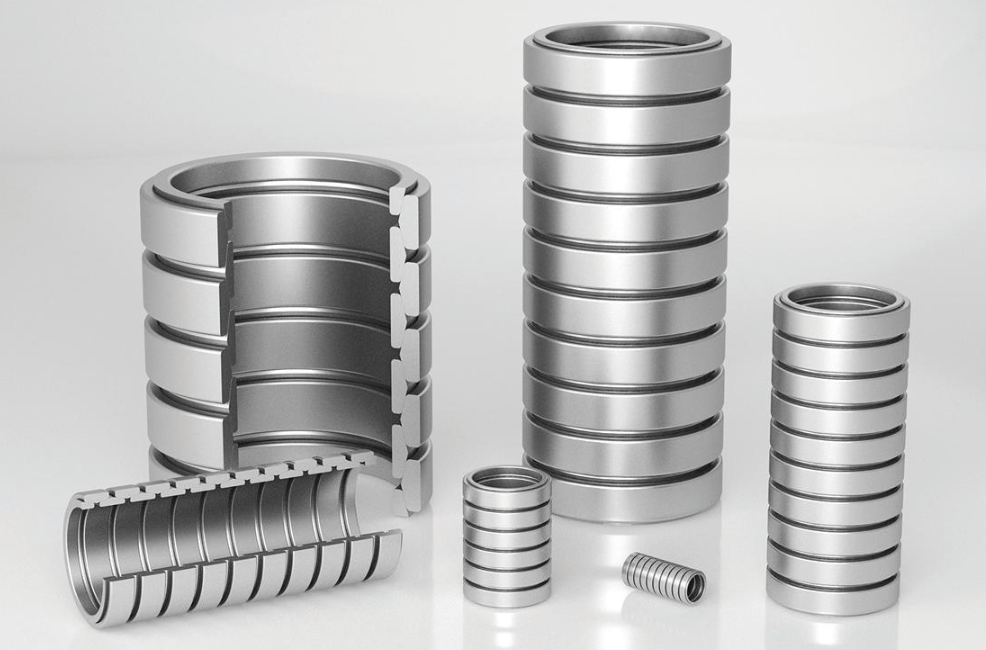
In the field of industrial shock absorption and vibration control, friction springs are widely used yet often misunderstood components. At first glance, their structure appears straightforward, but in practice engineers frequently encounter difficulties when analyzing their behavior. Compared with conventional springs, friction springs involve additional complexities in their working principles, calculation methods, and application scenarios, which often leads to confusion during design and selection.
I. Why does the load curve look “non-linear”?
A common question from engineers is:
Why doesn’t a friction spring show a simple linear force–displacement relationship like a standard compression spring?
For ordinary compression springs, force increases proportionally with displacement, forming a nearly straight-line characteristic. However, friction springs operate differently due to internal conical surface friction. During compression, energy is continuously dissipated through friction, which leads to:
-
A distinct loading curve
-
A different unloading curve
These two curves do not coincide, instead forming a hysteresis loop.
This loop is the defining feature of friction springs, as it represents their ability to absorb and dissipate impact energy.
For engineers who are more familiar with linear spring models, this hysteresis behavior often makes theoretical analysis and parameter selection more challenging.
II. Why is preload required?
Another frequently asked question is:
Why must friction springs be installed with preload?
Unlike many conventional spring systems, friction springs cannot operate properly without an initial preload. If preload is not applied:
-
Stable friction between the inner and outer components cannot be established
-
The damping effect becomes weak or inconsistent
-
The overall working performance may become unstable
In most engineering practices, the recommended preload level is around 5%–10% of the total stroke.
If preload is too low, sufficient friction cannot be generated. If it is too high, it may increase wear, reduce lubrication effectiveness, and shorten service life.
Therefore, determining a reasonable preload value in actual mechanical structures is one of the key design challenges engineers must address.
III. Why do specifications differ significantly between manufacturers?
Engineers often notice that friction spring data varies considerably across different suppliers, including:
-
Rated load differences
-
Stroke variations
-
Energy absorption capacity discrepancies
This is not only due to dimensional differences, but also influenced by multiple manufacturing and processing factors, such as:
-
Material selection
-
Surface treatment processes
-
Precision of friction surface machining
-
Lubrication type and condition
All these factors directly impact the final mechanical performance of the product.
As a result, even friction springs with similar dimensions may exhibit noticeably different operating characteristics depending on the manufacturer’s design and production standards.
http://www.raleigh-springs.com
Raleigh Spring Technology Co., Ltd. -
-
AuthorPosts

- You must be logged in to reply to this topic.