- This topic is empty.
-
AuthorPosts
-
02/11/2026 at 19:27 #6781
■ 1. Background
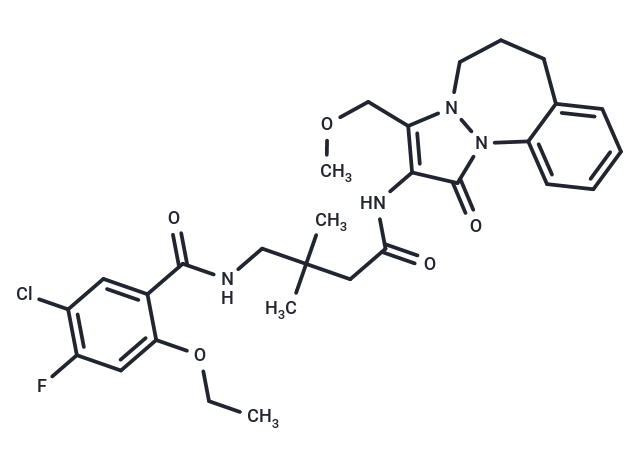
▲ CB-6644 (T10693),CAS: 2316817-88-4
CB-6644 (T10693), CAS: 2316817-88-4 is a small-molecule inhibitor that targets the RUVBL1/2 complex, a pair of evolutionarily conserved AAA+ ATPases that function as obligate partners in a wide array of chromatin- and RNA-associated assemblies. CB-6644 directly engages RUVBL1/2 in cancer cells and potently suppresses the ATPase activity of the hetero-oligomeric complex with an IC50 of 15 nM, thereby blocking the energy-dependent conformational transitions that drive its remodeling and assembly functions. Because RUVBL1/2 use ATP hydrolysis to fuel dynamic interactions within multi-subunit machines, ATPase inhibition by CB-6644 is expected to decouple RUVBL1/2 scaffolding from its mechano-chemical work, selectively impairing processes that depend on catalytic turnover.
RUVBL1/2 are integral to several key chromatin-modifying and remodeling platforms, including the TIP60/p400 acetyltransferase complex and INO80-related remodelers, where they stabilize complex architecture, regulate catalytic subunits, and promote nucleosome editing at sites of active DNA repair and transcription [1,2]. Beyond chromatin, RUVBL1/2 contribute to DNA replication initiation, maintenance of genome stability, and aspects of RNA biogenesis such as assembly of RNA polymerase and small nucleolar RNPs. Functionally, these activities converge on DNA/RNA synthesis: RUVBL1/2 facilitate access of replication and transcription machinery to chromatin, coordinate DNA damage responses that safeguard replication forks, and support maturation of RNA-processing complexes. Consequently, the RUVBL1/2 ATPase constitutes a nodal effector that integrates chromatin state with transcriptional output and replication competence.
By inhibiting the ATPase step, CB-6644 modulates this network at its mechanistic core. In models where RUVBL1/2 drive TIP60-dependent histone acetylation or INO80-mediated nucleosome sliding, ATPase blockade is anticipated to blunt chromatin remodeling kinetics, dampen transcriptional programs that require rapid promoter or enhancer remodeling, and constrain DNA repair-coupled chromatin resetting. In replication and RNA biogenesis contexts, CB-6644 provides a means to acutely perturb assembly pathways that are ATPase-dependent, enabling separation-of-function analyses between RUVBL1/2’s catalytic and structural roles.
These properties give CB-6644 substantial research utility. As a high-potency chemical probe, it enables time-resolved interrogation of RUVBL1/2 dependency in cancer cell models where these ATPases support oncogenic transcriptional drivers or replication stress tolerance. Combining CB-6644 with genomic readouts (RNA-seq, nascent transcription/replication assays) and chromatin profiling (ChIP-seq/ATAC-seq) can map ATPase-dependent gene regulatory circuits and chromatin transitions. In DNA damage studies, CB-6644 can be used to test how RUVBL1/2 ATP hydrolysis influences repair pathway choice and chromatin restoration kinetics. Proteomic or complex-assembly assays under CB-6644 exposure can delineate ATPase-coupled assembly checkpoints across TIP60/INO80 and RNA biogenesis machineries. Finally, chemical–genetic interaction mapping with CB-6644 can identify synthetic vulnerabilities that arise when RUVBL1/2-driven remodeling is limited, informing mechanistic hypotheses about epigenome maintenance and genome replication control [1,2].
■ 2. Literature review
■ 2.1 Rapid Optimization Enabled by Single-Molecule Tracking: Discovery of a Potent RUVBL1/2 Inhibitor to Evaluate the Targeting of MYC-Driven Cancers.
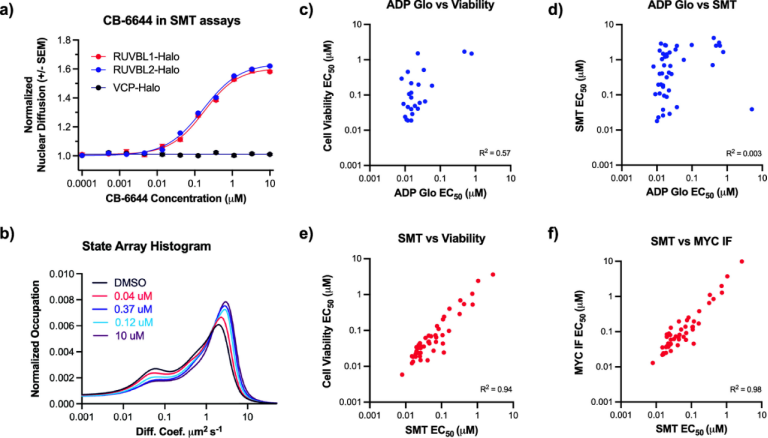
▲ (a) Upon treatment with CB-6644, a dose-dependent increase in the nuclear diffusion of RUVBL1 or RUVBL2 proteins is observed respectively in Halo-tagged cells, with the diffusion ratio representing the ratio of mean diffusion coefficients derived from the full diffusion coefficient distributions at each concentration; no diffusion change is observed for VCP-Halo cells. (b) A state-array histogram showing the distribution of diffusion states for the RUVBL1-Halo protein. (c) The ADP-Glo assay (x-axis) shows poor correlation with cell viability (R²=0.57), and (d) RUVBL SMT assays (R²=0.003). (e) In contrast, the RUVBL SMT assay (x-axis) shows improved correlation with cell viability (R²=0.94), and (f) correlates strongly with in vitro MYC degradation assay results (R²=0.98).
CB-6644 (T10693) is described as a direct-binder and inhibitor of RUVBL. In pharmacokinetic modeling, a 150 mg/kg BID dose of CB-6644 maintained target coverage above the cellular EC50 for approximately 6 hours. In vivo, CB-6644 produced 70% tumor growth inhibition at a 150 mg/kg BID dose. Under selective pressure with CB-6644, RUVBL1 point mutants were recurrently identified in HCT116 cells, and genomic sequencing confirmed recurrence of the RUVBL1 R117H mutation. Functionally, CB-6644 exhibited a marked sensitivity shift in this context: the EC50 increased by more than 20-fold in RUVBL1 R117H mutants compared with wild-type cells. In pathway-focused assays, CB-6644 inhibited the etoposide-induced upregulation of phospho-CHK2 when coadministered in HCT116 cells, consistent with on-pathway engagement of the DNA damage response axis. Across a mini-panel stratified by MYC expression, CB-6644 displayed similar average EC50 values in both MYC High and MYC Low cell groups. Collectively, these findings characterize CB-6644 as a RUVBL-targeting small molecule with demonstrated target engagement, pathway modulation, and in vivo tumor growth inhibition, alongside evidence that specific RUVBL1 mutations are associated with substantial shifts in cellular potency.[3]
■ 2.2 Targeting RuvBL1 disrupts mitochondrial metabolism and structure in hepatocellular carcinoma.
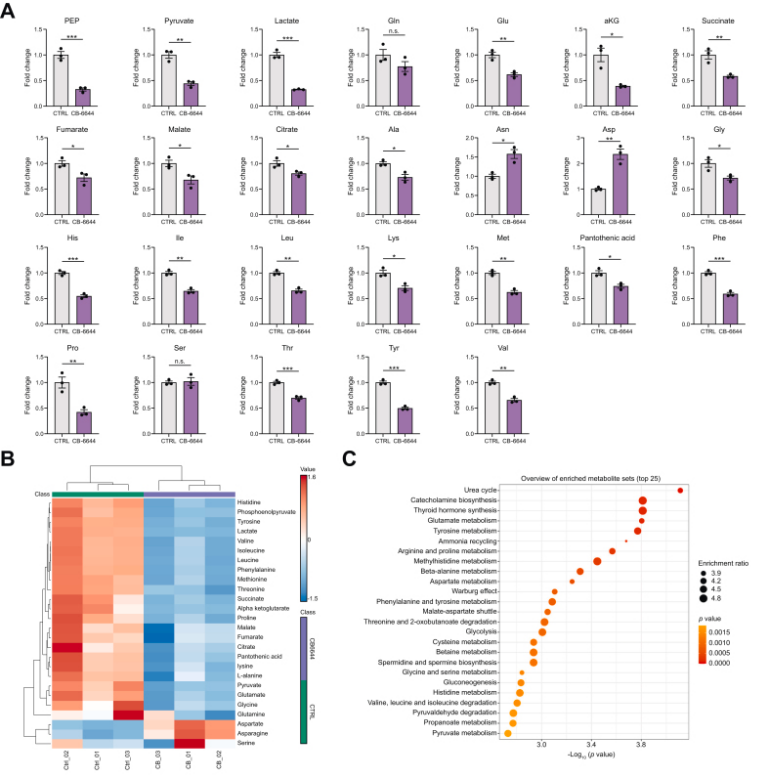
▲ Targeting RuvBL1/2 ATPase activity impairs cellular metabolism. (A) Targeted metabolomic analysis of Huh7 cells treated with 0.5 μM CB-6644 for 48 h. Normalized AUC values (mean ± SEM) from three independent experiments are reported. Unpaired Student’s t test was used for statistical significance. ∗p < 0.05, ∗∗p < 0.01, ∗∗∗p < 0.001. (B) Hierarchical clustering of the analyzed metabolites in CB-6644-treated Huh7 cells. (C) Enrichment analysis performed with Metaboanalyst in CB-6644-treated Huh7 cells.
CB-6644 (T10693) targets RuvBL1/2 ATPase activity and was used to probe mitochondrial and metabolic functions in hepatocellular models. In Huh7 cells, targeted metabolomics after exposure to 0.5 μM for 48 hours showed that the levels of most analysed amino acids were significantly decreased, whereas aspartate and asparagine were increased by CB-6644. Quantitative enrichment analysis separated CB-6644-treated cells from controls by principal component analysis and highlighted enrichment of pathways including the urea cycle, malate–aspartate shuttle, Warburg effect, and amino acid metabolism. Across hepatocyte-derived lines and primary mouse hepatocytes, CB-6644 affected basal respiratory capacity in a time- and dose-dependent manner, with higher doses inhibiting oxidative phosphorylation after 24 hours and lower doses becoming effective after 48 hours. Mechanistically, CB-6644 upregulated ATPAF2 in immunoprecipitated mitochondria, and several ATP synthase subunits were also upregulated. Despite these changes, mitochondrial ATP production measured in digitonin-permeabilised Huh7 cells under a fuelled TCA cycle and with exogenous ADP was clearly reduced by CB-6644. Consistent with these functional effects on complex V, ATPIF1 expression was increased in a dose-dependent manner. Super-resolution and proximity assays placed RuvBL1 in proximity to F1-ATP synthase, and CB-6644 induced a moderate but consistent reduction of the RuvBL1–ATPB interaction. In line with this proximity-based mechanism, CB-6644 reduced ATP synthase–RuvBL1 interaction and impaired complex V activity even under a fuelled TCA cycle.[4]
■ 2.3 CB-6644 Is a Selective Inhibitor of the RUVBL1/2 Complex with Anticancer Activity.

CB-6644 (T10693) is a RUVBL1/2 inhibitor. In MOLM-16 cells, combining CDK8 inhibitors with CB-6644 led to a notable impairment of cell growth, observed after 6, 9, and 12 days of exposure, and growth inhibition rates from single and combined treatments indicated additive effects. In cellular analyses, CB-6644 mainly inhibited DNA replication in MOLM-16 cells. When CB-6644 was combined with CDK8 inhibitors, the treatment produced both reduced DNA replication, consistent with the effect of CB-6644 alone, and increased cell death relative to CDK8 inhibitor monotherapy. These data indicate that CDK8 inhibitors and CB-6644 exert distinct effects on cell growth and survival. Together, the findings describe a profile for CB-6644 in this AML context characterized by direct suppression of DNA replication and an additive impairment of MOLM-16 cell growth when used alongside CDK8 inhibitors, with the combination further elevating cell death compared to CDK8 inhibitors alone.[5]
■ 3. Conclusion
CB-6644 functions by selectively inhibiting the ATPase activity of the RUVBL1/2 complex, thereby blocking ATP hydrolysis-driven conformational changes essential for chromatin remodeling, DNA repair, replication, and RNA biogenesis. Literature reports demonstrate that CB-6644 achieves potent target engagement with an IC50 of 15 nM, leads to significant tumor growth inhibition in vivo, and induces marked metabolic shifts including disruption of mitochondrial oxidative phosphorylation. Additionally, CB-6644 suppresses DNA replication and synergizes with CDK8 inhibitors to enhance cancer cell death. These findings highlight CB-6644 as a valuable chemical probe for dissecting RUVBL1/2-dependent processes and suggest its potential application in targeted cancer therapies, especially in contexts involving replication stress and oncogenic transcription. Future research may explore combination strategies with other epigenetic or metabolic inhibitors and further elucidate RUVBL1/2’s roles in genome stability and mitochondrial function.
■ 4. Q&A
Q1: What is the molecular target and mechanism of CB-6644?
A1: CB-6644 selectively targets the RUVBL1/2 complex by inhibiting its ATPase activity, thereby blocking ATP hydrolysis-dependent conformational changes essential for chromatin remodeling and related biological processes.
Q2: What are the key biological effects of CB-6644 observed in cancer models?
A2: CB-6644 potently inhibits tumor growth in vivo, disrupts mitochondrial metabolism and oxidative phosphorylation, suppresses DNA replication, and shows additive anti-proliferative effects when combined with CDK8 inhibitors.
Q3: How does CB-6644 contribute to understanding RUVBL1/2 functions?
A3: As a high-potency chemical probe, CB-6644 allows time-resolved analysis of RUVBL1/2-dependent gene regulatory circuits, chromatin remodeling, DNA repair dynamics, and synthetic lethality interactions in cancer cells.
■ 5. Reference
[1] Grigoletto A, Lestienne P, et al. The multifaceted proteins Reptin and Pontin and their roles in cancer. Biochim Biophys Acta. 2011;1815(2):147-157.
[2] Jha S, Dutta A, et al. RVB1/RVB2: essential ATP-dependent helicases of the AAA+ superfamily in transcription, chromatin remodeling, and DNA repair. Cell Cycle. 2009;8(19):3184-3190.
[3] Zheng L, Park E, Lenihan J, Forrest W, Zhou X, Fong C, et al.. Rapid Optimization Enabled by Single-Molecule Tracking: Discovery of a Potent RUVBL1/2 Inhibitor to Evaluate the Targeting of MYC-Driven Cancers.. Journal of medicinal chemistry. 2026;69(10):12048-12068.
[4] Mello T, Simeone I, Guida A, Papini D, Begnozzi F, Santi A, et al.. Targeting RuvBL1 disrupts mitochondrial metabolism and structure in hepatocellular carcinoma.. JHEP reports : innovation in hepatology. 2026;8(7):101858.
[5] Assimon V, Tang Y, Vargas J, Lee G, Wu Z, Lou K, et al.. CB-6644 Is a Selective Inhibitor of the RUVBL1/2 Complex with Anticancer Activity.. ACS chemical biology. 2019;14(2):236-244.
http://www.targetmol.com
TargetMol Chemicals Inc. -
AuthorPosts

- You must be logged in to reply to this topic.