- This topic is empty.
-
AuthorPosts
-
09/11/2026 at 14:37 #6854
Choosing a reliable ballistic helmet pads manufacturer is an important step for businesses involved in helmet production, equipment distribution, and customized protective gear development. Although helmet pads may appear to be relatively simple components, their materials, structural design, manufacturing precision, and quality consistency can significantly influence the fit, comfort, and overall usability of a helmet system.
For buyers sourcing ballistic helmet pads, evaluating a manufacturer requires more than comparing product specifications or checking whether a supplier offers different pad shapes. It is also necessary to understand the manufacturer's production capabilities, material selection process, quality control procedures, customization services, and ability to maintain consistent standards across multiple orders.
A qualified manufacturer should be able to explain how its products are developed, how production quality is controlled, and how different requirements can be addressed through material and structural adjustments. This article explores the key factors buyers should consider when evaluating a ballistic helmet pads manufacturer and provides a practical framework for making a more informed sourcing decision.
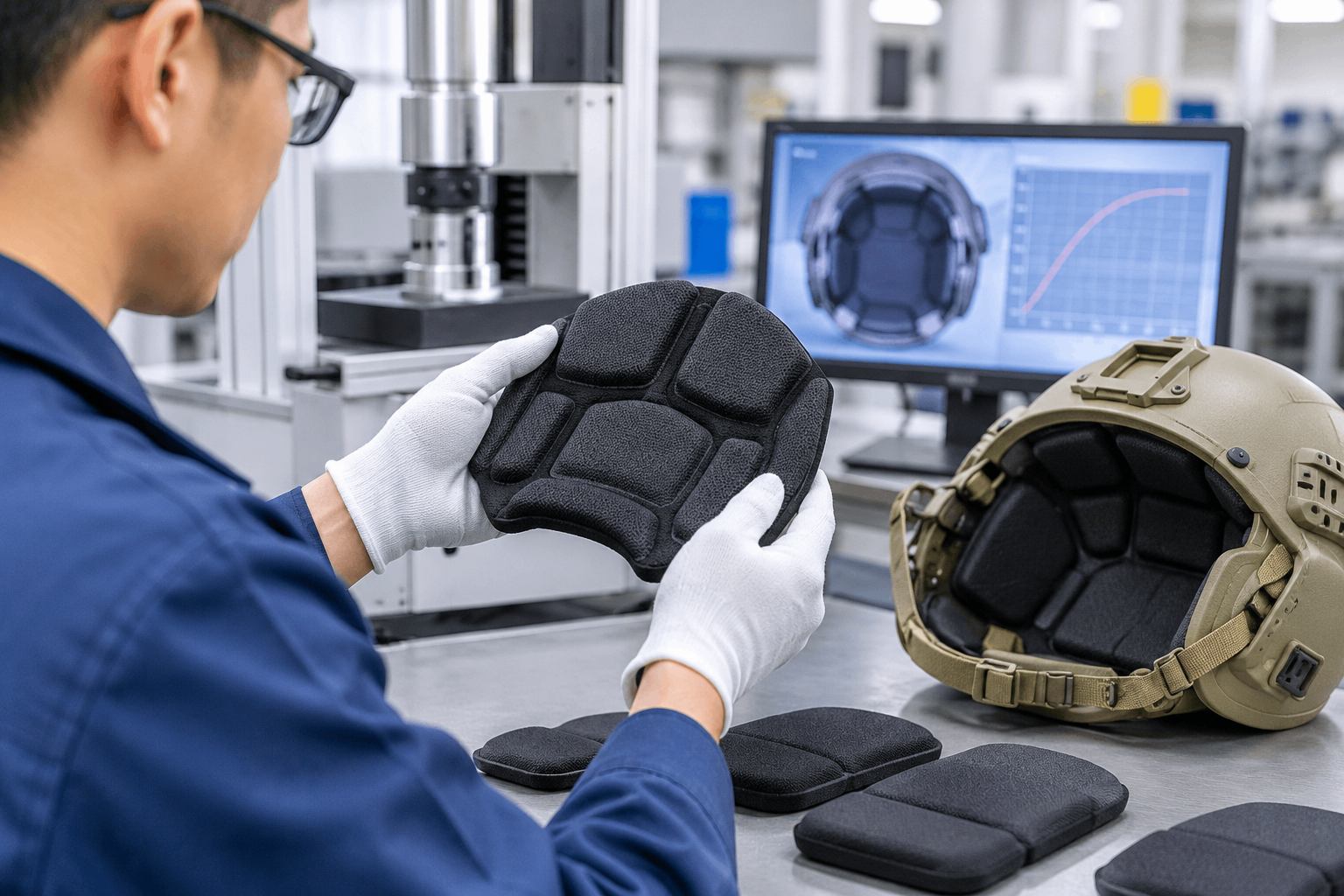
1. Examine the Manufacturer's Industry Experience
Industry experience is a useful starting point when assessing a ballistic helmet pads manufacturer. A company with established experience in foam processing, textile manufacturing, molded components, or helmet accessories may have a better understanding of the technical requirements involved in producing helmet padding systems.
However, the number of years a company has been operating should not be the only consideration. Buyers should also examine whether the manufacturer's actual production experience is relevant to the products being sourced.
For example, a manufacturer specializing in general foam cushions may not necessarily have the same capabilities as a company experienced in producing compact, contoured helmet pads. Helmet padding requires attention to dimensions, surface characteristics, thickness consistency, attachment structures, and compatibility with different helmet interiors.
When reviewing a manufacturer's background, consider the following questions:
-
How long has the company been manufacturing helmet padding or related components?
-
Does it have experience producing different types of helmet pads?
-
Can it provide product specifications and technical documentation?
-
Has it worked with different helmet structures and interior configurations?
-
Does it have experience handling customized production requirements?
A manufacturer's answers can help buyers distinguish between a company with relevant manufacturing knowledge and a supplier that mainly resells products from other factories.
2. Evaluate the Materials Used in Helmet Pads
Material selection directly affects the physical characteristics of ballistic helmet pads. Different materials have different levels of flexibility, resilience, density, surface durability, and resistance to environmental conditions.
Common materials used in helmet padding include various types of foam, molded cushioning materials, and fabric-covered components. The appropriate choice depends on the intended product design, required dimensions, expected usage conditions, and compatibility with the helmet structure.
When evaluating a manufacturer, buyers should ask for detailed information about its material options rather than relying on general descriptions such as soft, comfortable, or durable.
Important material characteristics include:
Foam density: Density influences the physical structure and firmness of foam. Different density options may be suitable for different pad designs and user preferences. However, density alone does not establish the overall quality or protective performance of a complete helmet.
Compression behavior: Helmet pads are subjected to repeated pressure during normal use. Buyers should understand how the selected material responds to compression and whether it can maintain its intended shape under specified conditions.
Resilience: Resilience describes how a material responds after being compressed or deformed. Consistent material behavior helps maintain predictable product characteristics over time.
Surface durability: The outer surface should be suitable for regular handling and contact. Material covering, stitching, and edge finishing can all influence the product's resistance to everyday wear.
Environmental resistance: Temperature, humidity, perspiration, and storage conditions may affect certain foam and fabric materials. Manufacturers should be able to explain the environmental limitations of their selected materials.
A professional ballistic helmet pads manufacturer should provide clear material specifications and help buyers understand the differences between available options. This information makes it easier to select products that match the intended application.
3. Check Manufacturing Equipment and Production Processes
Manufacturing capability is another important factor when evaluating potential suppliers. Even when two manufacturers use similar raw materials, differences in equipment, processing methods, and production management can lead to variations in finished products.
Helmet pads often require accurate cutting, shaping, molding, bonding, sewing, or other assembly operations. Each process must be controlled to ensure that the final components meet the required dimensions and structural specifications.
For example, inaccurate cutting may result in inconsistent pad dimensions. Poor bonding can cause different material layers to separate, while uneven stitching may affect the appearance and durability of fabric-covered components.
Buyers should therefore investigate the manufacturer's production processes and available equipment.
Useful questions include:
-
Does the manufacturer have dedicated production equipment for foam cutting and shaping?
-
Can it produce pads with different thicknesses and contours?
-
Are cutting and assembly processes standardized?
-
How does the factory control dimensional accuracy?
-
Are production procedures documented and regularly reviewed?
A factory with well-organized production processes is generally better positioned to manage repeat orders and maintain consistent product specifications.
It is also helpful to understand which operations are completed in-house and which are outsourced. A manufacturer that controls important production stages directly may have greater visibility over quality and delivery schedules.
4. Assess Product Design and Customization Capabilities
Different ballistic helmets may have different internal structures, available installation spaces, and attachment arrangements. As a result, one standard pad configuration may not be suitable for every helmet model.
A capable manufacturer should offer more than a limited selection of standard products. It should also be able to discuss customization requirements and determine whether its existing production processes can accommodate them.
Customization may involve several aspects.
Pad shape and dimensions: Different helmet interiors may require different pad outlines, lengths, widths, and thicknesses. Accurate dimensional matching is essential for proper installation.
Material combinations: Buyers may need to select different foam materials, surface fabrics, or layered structures depending on the desired product characteristics.
Attachment methods: Hook-and-loop fasteners, adhesive-backed components, and other attachment arrangements may be used depending on the helmet's interior design.
Pad configurations: Manufacturers may provide different numbers, shapes, and arrangements of pads to accommodate specific helmet structures.
Branding and packaging: For distributors and private-label businesses, customized labels, packaging specifications, and product identification may also be important.
Before placing a customized order, buyers should ask whether the manufacturer can produce samples for evaluation. Sample development provides an opportunity to confirm dimensions, material characteristics, attachment compatibility, and finishing quality before proceeding to larger production quantities.
5. Review Quality Control Procedures
Quality control is one of the most important aspects of evaluating a ballistic helmet pads manufacturer. A product may appear satisfactory during an initial inspection but still contain inconsistencies that become apparent across larger production batches.
A reliable manufacturer should have defined inspection procedures covering raw materials, production processes, and finished products.
The quality control process should ideally include several stages.
Incoming material inspection
Raw materials should be checked before entering production. This may involve verifying material specifications, dimensions, appearance, and other characteristics required by the product design.
In-process inspection
During manufacturing, production staff should monitor important parameters such as cutting dimensions, thickness, bonding quality, stitching, and component alignment.
Finished product inspection
Completed helmet pads should be inspected against approved specifications. Typical checks may include:
-
Length, width, and thickness measurements
-
Surface condition and material consistency
-
Stitching quality and edge finishing
-
Bonding strength and layer adhesion
-
Attachment component condition
-
Overall appearance and workmanship
Batch consistency checks
For repeat orders, the manufacturer should maintain clear product specifications and inspection records. This helps reduce variations between different production batches.
Buyers should ask whether the factory maintains inspection documentation and how it handles products that fail to meet established requirements.
A manufacturer that can explain its quality control procedures in practical detail is generally easier to evaluate than one that only makes broad claims about product quality.
6. Verify Product Compatibility and Installation Details
Compatibility is a critical consideration when sourcing ballistic helmet pads. Even a well-manufactured pad may not perform as expected in practical use if its dimensions, shape, or attachment arrangement do not match the intended helmet.
Before selecting a supplier, buyers should provide as much information as possible about the target helmet structure.
Relevant details may include:
-
Helmet interior dimensions
-
Available installation space
-
Existing attachment surfaces
-
Required pad thickness
-
Pad shape and positioning
-
Preferred attachment method
The manufacturer should be able to review these requirements and identify potential compatibility issues before production begins.
It is also advisable to request installation samples or technical drawings where appropriate. These materials allow buyers to check whether the pads fit the intended interior configuration and whether the attachment components are positioned correctly.
Another important point is product consistency. If the same helmet model requires repeated orders of replacement pads, the manufacturer should be able to reproduce the approved dimensions and configuration accurately.
Clear communication about compatibility can reduce unnecessary sample revisions, production delays, and product returns.
7. Investigate Certifications and Quality Documentation
Certifications and technical documents can provide additional information about a manufacturer's management systems and production capabilities. However, buyers should understand what each document actually demonstrates instead of assuming that every certification guarantees the performance of a specific product.
For example, an ISO 9001 certificate indicates that a company operates a quality management system within its certified scope. It does not automatically verify every material characteristic or establish the protective performance of a complete helmet.
When evaluating a ballistic helmet pads manufacturer, buyers may request relevant documents such as:
-
Company business registration information
-
Quality management system certificates
-
Material specifications
-
Product drawings and dimensional requirements
-
Inspection reports
-
Material test reports, where applicable
-
Production and batch traceability records
The validity and scope of certifications should also be checked. A certificate issued to a company may cover certain manufacturing activities but not necessarily every product category offered by the supplier.
If the buyer has specific testing or documentation requirements, these should be discussed before confirming the order. The manufacturer should clarify which tests it can conduct internally and which require an independent testing organization.
It is particularly important to distinguish between documentation related to comfort and fit characteristics and testing that applies to the complete helmet system. Helmet pads are individual components, and their specifications alone should not be treated as proof of overall helmet protection.
8. Evaluate Sample Quality Before Bulk Purchasing
Samples provide a practical way to assess whether a manufacturer's claims match its actual products. Before placing a large order, buyers should request representative samples and compare them with the agreed specifications.
During sample evaluation, pay attention to several details.
Dimensional accuracy: Measure the pad dimensions and compare them with the technical drawing or approved specification.
Material consistency: Check whether the foam, fabric, and other materials match the information provided by the manufacturer.
Surface finishing: Inspect the surface for uneven edges, visible defects, loose threads, or inconsistent stitching.
Structural integrity: Examine bonded layers and attachment components to identify potential separation or assembly problems.
Installation compatibility: Place the pads inside the intended helmet structure to check positioning and attachment.
Appearance consistency: If several samples are provided, compare their dimensions, shapes, and surface finishes.
Buyers should also evaluate how the manufacturer responds to feedback. If a sample does not meet the required specifications, a professional supplier should be able to identify the issue, suggest adjustments, and provide a revised sample where necessary.
The sample approval process should be documented. This creates a clear reference for subsequent mass production and helps prevent misunderstandings about the final product.
Conclusion
Evaluating a ballistic helmet pads manufacturer requires a comprehensive understanding of its materials, manufacturing processes, product design capabilities, quality control system, customization services, and supply reliability. Buyers should look beyond product appearance and quotation prices to determine whether a supplier can consistently meet technical specifications and support long-term procurement requirements.
A practical approach is to begin with the manufacturer's background, review its material and production capabilities, request relevant documentation, and evaluate product samples before placing bulk orders. Clear communication about dimensions, attachment methods, compatibility, and quality expectations is also essential for achieving consistent results.
For businesses sourcing helmet padding components, working with an experienced manufacturer can make product development and procurement more manageable. HONG JIA focuses on manufacturing-related capabilities and product requirements, providing buyers with a basis for discussing helmet pad specifications, material options, and customized solutions. By establishing clear requirements and maintaining effective communication throughout the sourcing process, businesses can build more reliable supplier relationships and make better-informed decisions when purchasing ballistic helmet pads.
http://www.militarytex.com
militarytex -
-
AuthorPosts

- You must be logged in to reply to this topic.