- This topic is empty.
-
AuthorPosts
-
26/11/2026 at 14:02 #7013
Cell-based experiments play an important role in pharmaceutical research, biotechnology development and modern life sciences. Whether researchers are studying cell growth, evaluating drug responses or monitoring tissue cultures, reliable microscopic observation is essential for obtaining meaningful experimental results.
In everyday laboratory work, however, microscopy can involve practical challenges. Culture vessels come in different sizes, living cells may have limited natural contrast, and repeatedly transferring samples for observation can interrupt established procedures. These factors make equipment selection an important consideration.
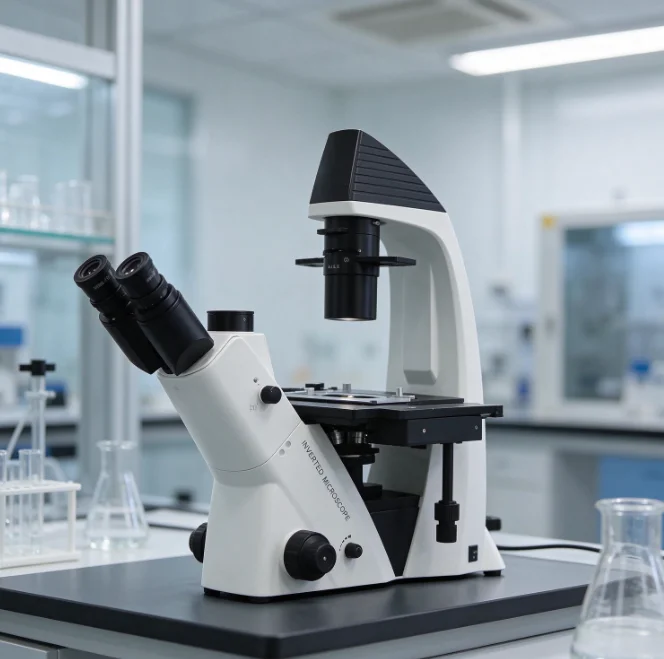
An Inverted Biological Microscope offers a practical solution for laboratories that regularly examine living cells in culture dishes, flasks and multi-well plates. Rather than focusing solely on magnification, researchers should also evaluate working distance, contrast techniques, stage design and imaging compatibility.
1. Why Laboratories Use Inverted Microscopes for Cell Culture
Cell cultures are commonly used in pharmaceutical screening, cytotoxicity studies and biological experiments. Researchers need to observe cell attachment, morphology, proliferation and other visible changes throughout the experimental process.
Unlike conventional upright microscopes, which are primarily designed for specimens mounted on slides, inverted microscopes have objective lenses positioned beneath the stage. This configuration allows researchers to view cells through the transparent bottom of compatible culture containers.
One major advantage is that samples can often remain in their original vessels during routine observation. This reduces unnecessary handling and makes it easier to monitor cell development at different stages.
For laboratories working with adherent cells or conducting regular culture inspections, this arrangement can help simplify daily workflows and maintain more consistent observation procedures.
2. Working Distance and Culture Vessel Compatibility
Working distance is an important specification when evaluating an inverted microscope. Since cell cultures are maintained in containers with different dimensions and bottom materials, the optical system must provide sufficient clearance for practical observation.
A microscope with limited working distance may restrict the types of vessels that can be accommodated or make focusing more difficult when containers are relatively tall.
Before purchasing equipment, laboratories should pay attention to several details:
-
The thickness and optical properties of the culture vessel bottom.
-
The height and overall dimensions of culture dishes and flasks.
-
Objective working distances at different magnification levels.
-
The clearance between the condenser, stage and sample.
-
Compatibility with commonly used multi-well plates.
The Zhenxin BDS400 inverted biological microscope is equipped with a long-working-distance condenser featuring an NA of 0.30 and a working distance of 72 mm. When the condenser is removed, the working distance can reach 195 mm. This provides additional clearance for different sample arrangements and taller culture vessels.
3. Enhancing Cell Visibility with Phase Contrast
One difficulty in observing living cells is their relatively low natural contrast. Many unstained cells are nearly transparent under standard brightfield illumination, making their boundaries and internal morphological features difficult to distinguish.
Phase contrast microscopy helps address this problem by converting differences in optical path length into variations in image brightness. Researchers can therefore observe many transparent specimens without applying additional staining agents.
This technique is particularly useful for routine cell culture assessment, including checking cell attachment, identifying morphological changes and monitoring growth conditions.
Nevertheless, phase contrast is not a universal solution. Thick specimens may produce halo artifacts, and experiments requiring the identification of specific proteins or cellular components may need fluorescence microscopy instead.
The appropriate observation method should therefore be determined by specimen characteristics and research objectives, rather than magnification alone.
4. Making Multi-Well Plate Observation More Convenient
Multi-well plates are frequently used in cell-based assays, drug screening and comparative biological experiments. When researchers need to inspect multiple wells, accurate and repeatable positioning can have a significant effect on workflow efficiency.
A suitable mechanical stage makes it easier to move between observation points and locate specific samples. Its movement range, adjustment precision and compatibility with different plate formats should all be considered during equipment selection.
For example, the Zhenxin BDS400 offers an optional mechanical stage designed for 96-well plate observation, with a movement range of 128 mm × 80 mm. This configuration provides additional flexibility when positioning samples during routine inspection.
For laboratories that need to preserve experimental records or share observation results, digital camera compatibility is another useful consideration. Image capture and documentation can support result comparison and research communication.
5. Key Considerations When Selecting an Inverted Biological Microscope
The right microscope should support the laboratory's actual applications while allowing room for future requirements. Before making a purchasing decision, consider the following factors:
-
Optical configuration: Check objective magnifications, numerical aperture and available contrast methods to ensure they meet the requirements of the specimens being examined.
-
Vessel compatibility: Confirm that the stage and optical clearance accommodate the culture dishes, flasks and multi-well plates used in daily experiments.
-
Imaging options: Evaluate whether digital cameras, imaging adapters or fluorescence accessories may be needed for future applications.
-
Ease of operation: Consider focusing controls, stage movement and illumination adjustment, especially when equipment is used frequently.
-
Technical support: Review product documentation, accessory availability and the supplier's ability to provide technical assistance.
The Zhenxin BDS400 supports multiple infinity-corrected objective configurations and a wide-field eyepiece. Optional digital imaging and epi-fluorescence accessories also provide laboratories with additional configuration choices according to their observation needs.
6. Matching Microscopy Equipment to Laboratory Workflows
Choosing an inverted microscope is not simply a matter of selecting the highest available magnification. Working distance, optical contrast, sample positioning and imaging options all influence its suitability for daily laboratory applications.
For researchers who regularly examine cultured cells and other biological specimens, an appropriately configured inverted biological microscope can make routine observation more convenient while reducing unnecessary sample handling.
By assessing existing experimental procedures and likely future applications before purchasing, laboratories can select equipment that offers practical functionality without investing in features that may not be required.
As cell culture techniques continue to support pharmaceutical and biotechnology research, application-focused microscopy equipment remains an important part of efficient laboratory operations.
http://www.zinscien.com
Shanghai Zinscien Technology Co., Ltd. -
-
AuthorPosts

- You must be logged in to reply to this topic.