- This topic is empty.
-
AuthorPosts
-
12/11/2026 at 15:12 #6886
Published: November 2026 | By Qizhuo Engineering Team
Collect three quotations for "custom hologram labels" and you will often receive three completely different prices — not because suppliers are padding margins, but because three different origination technologies hide behind the same word. A 2D/3D layered master, a true-color 3D master and a dot-matrix master differ in how they are written, how long origination takes, and where they sit on the difficulty-of-counterfeiting curve. Buyers typing 2d vs 3d dot matrix hologram which is harder to fake into a search bar usually expect a simple ranking. The honest answer has a trap inside it, and this guide walks through it using production data from Qizhuo, a custom label manufacturer in Shanghai.
1. The Three Technologies in One Glance
2D/3D holograms place several flat images — your logo, text, a background pattern — on separate focal layers inside the master. Tilt the label and the layers shift against each other, creating a parallax depth effect that ordinary printing cannot reproduce. Origination is the most mature of the three, which keeps master fees and unit costs lowest. This tier is a solid visual deterrent for consumer goods facing casual counterfeiting.
True-color 3D holograms record a single continuous image that reads as a solid object floating inside the label — closer to a miniature sculpture than a layered card. The physics is harder: it demands real-model shooting or advanced synthesis and stricter lab conditions, so origination costs more. The payoff is a depth effect that is dramatically harder to imitate and, on shelf, far more convincing — one reason a true color 3d hologram for luxury brand authentication has become the default choice for watches, jewelry and premium spirits.
Dot-matrix holograms are written point-by-point by a computer-controlled laser. Each pixel is a tiny diffraction grating whose angle and spacing are set independently, which unlocks what the other two cannot do: kinetic animation. A bar that rolls across the label, an emblem that rotates, text that switches from "GENUINE" to "VOID" as you tilt — these effects are instantly memorable and easy for anyone to verify. Master writing takes hours to days, which is why dot-matrix origination quotes run higher.
2. Which Is Harder to Fake — and the Trap Inside the Answer
Read as a simple ladder, the answer is: 2D/3D is easiest to copy, true-color 3D is harder, dot-matrix is hardest — with e-beam origination (nano-scale features written by electron beam) above all three, reserved for banknotes and passports. But here is the trap: the honest answer to 2D vs 3D dot matrix hologram — which is harder to fake — depends on what was designed into the master, not which machine wrote it. Entry-level dot-matrix origination equipment has spread widely across the industry, so a generic dot-matrix pattern with a simple rolling bar is now easier to imitate than a well-engineered true-color 3D design. What actually raises the counterfeiting barrier inside any of the three technologies:
• Element-level encryption — individual pixels composed of micro-characters instead of plain gratings, so the "dots" only reveal letters under magnification.
• Dynamic channel design — multi-angle switching effects that take far longer to originate and demand tighter process control.
• Microtext and guilloche linework — banknote-grade details that a scanner picks up as noise. A custom 3d hologram sticker with micro text and guilloche typically carries text down to around 0.2 mm — invisible to the eye, crisp under a loupe — woven through the 3D layers.
Ask Qizhuo — or any supplier — one question: what in this design is genuinely hard to originate? A generic pattern on expensive equipment is a weaker barrier than a clever design on modest equipment.
3. Matching Technology to Threat Level
• Low threat (promotional goods, event tickets, low-value SKUs): 2D/3D layering is sufficient and cost-effective. Do not pay for technology your threat model does not need.
• Medium threat (electronics, cosmetics, spirits): true-color 3D or engineered dot-matrix, plus covert layers. This is also where true color 3d hologram for luxury brand authentication earns its keep — the sculptural depth reads as premium on shelf and simultaneously resists imitation, which is why watch, jewelry and premium spirits brands favor it.
• High threat (pharmaceuticals, tax stamps, documents): combined DOVID constructions — 2D/3D depth and dot-matrix kinetic effects originated into the same master — plus serialization and tamper-evident adhesive. Depth verifies naturally for non-experts; animation gives channel inspectors a five-second tilt check.
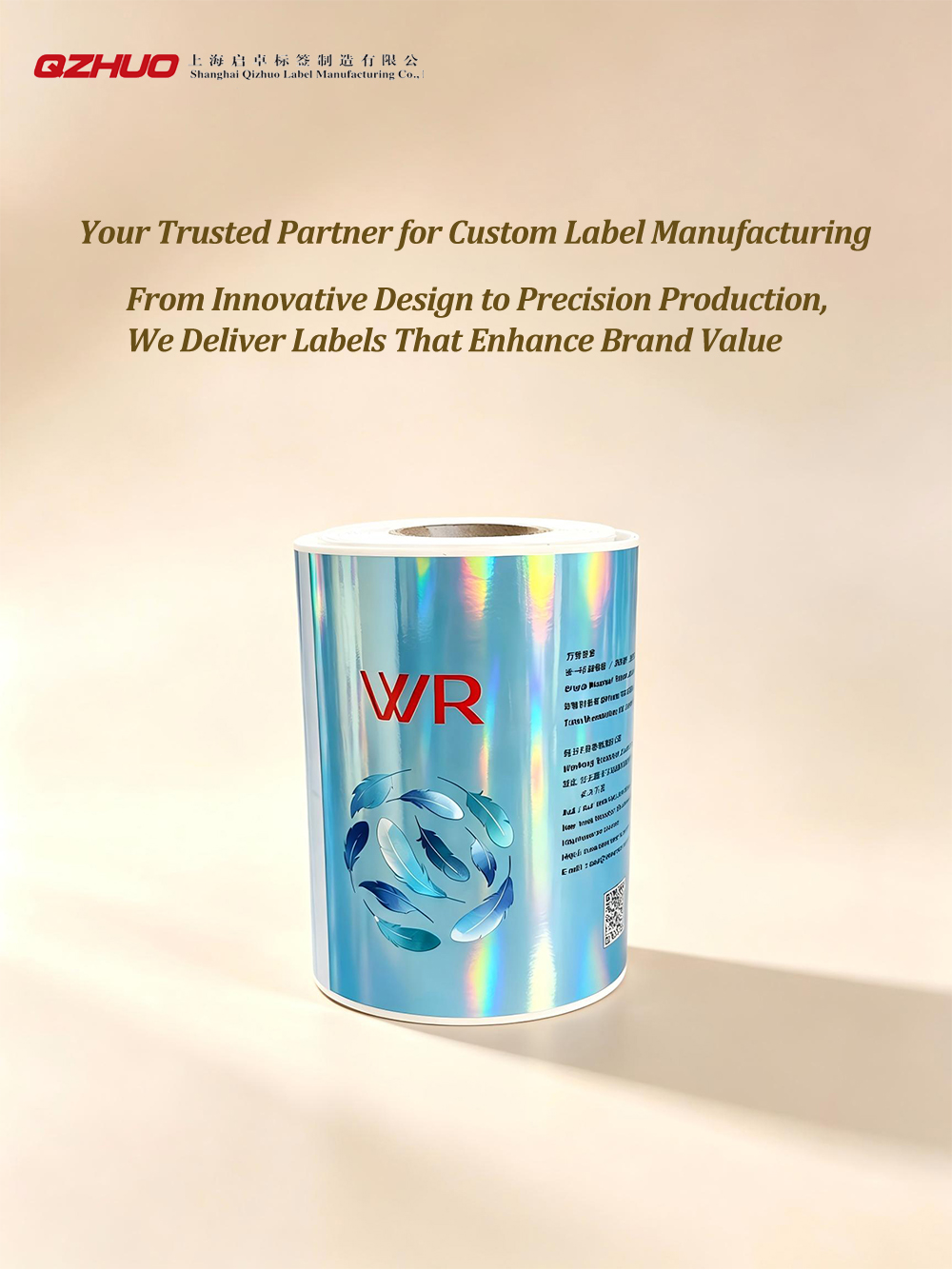
Whichever tier you choose, the optical layer is only half the label. Finishing decisions — screen-printed opaque panels, cold foil, protective varnish, die-cutting tolerance — determine whether the hologram survives application, transport and daily handling. Our 10-color flexographic line runs multi-layer and reverse-print security constructions in a single pass, and opaque elements for code windows are applied with silk screen printing on holographic film.
✅ Bottom line: Rank the design, not the machine — element-level encryption, dynamic channels and microtext raise the counterfeiting barrier far more than the origination technology label on the quote.
Frequently Asked Questions
Q: 2D vs 3D dot matrix hologram — which is harder to fake in practice?
A: Engineered dot-matrix with element-level encryption and dynamic channels is hardest, followed by true-color 3D, then 2D/3D — but a generic dot-matrix pattern is easier to copy than a well-designed 3D master, so judge the design content, not the technology name.
Q: How much does a custom master cost, and what is the MOQ?
A: Origination typically runs $5,000–25,000 depending on the effect, with custom hologram projects usually starting from 5,000 pieces per design. For a custom 3d hologram sticker with micro text and guilloche, unit prices at that scale settle in the $0.015–0.05 range, and the master becomes exclusive intellectual property for your brand.
Q: Can one label combine several hologram technologies?
A: Yes. Combined DOVID masters merge 2D/3D depth with dot-matrix animation, and the finished label can carry microtext, guilloche linework, UV elements and serialized QR codes in the same construction. Shanghai Qizhuo Label Manufacturing Co., Ltd. supports OEM and ODM projects across four printing processes — flexographic, offset, digital and screen — in one 3,700 m² facility, with 100% automatic inspection on every roll.
Not Sure Which Tier Fits Your Product?
Send Qizhuo your product category, quantity and the threat you are seeing in the market. Our engineers will recommend a master technology, quote factory-direct origination and unit pricing, and supply free samples applied to your actual substrate before you commit.
http://www.qzlabel.com
Shanghai Qizhuo Label Manufacturing Co., Ltd. -
AuthorPosts

- You must be logged in to reply to this topic.