- This topic is empty.
-
AuthorPosts
-
12/11/2026 at 09:40 #6883
Search for a “5G CPE industrial router,” and you will find the two terms used almost interchangeably. Both receive a 5G signal, both create a local network, and some products sit close to the boundary. Yet the two device families are designed around different goals, and picking the wrong one is a common reason why a 5G project works on the bench and disappoints in the field.
This article sets out eight practical questions about the site, explains which answers point towards a CPE and which towards an industrial router, and then works through four typical sites. E-Lins, which makes both 5G CPE and industrial 5G routers, is used as the reference throughout.
Two Devices, Two Design Goals
A CPE (customer premises equipment) is designed to bring broadband into a building or area. Its job is to capture the best possible signal and hand it to people and devices through Ethernet and Wi-Fi. An industrial router is designed to connect equipment: machines, controllers, cameras, and sensors, often at sites with no staff, unstable power, and harsh temperatures. Its job is to keep those devices reachable, securely, for years. The questions below are simply ways of finding out which of those two jobs your site actually has.
Eight Questions About the Site
1. Who or what will use the connection?
If the users are mainly people with laptops, phones, and tablets, a CPE is usually the natural fit. If the users are mainly machines, such as PLCs, meters, cameras, and controllers, lean towards an industrial router.
2. Do any devices use serial or digital interfaces?
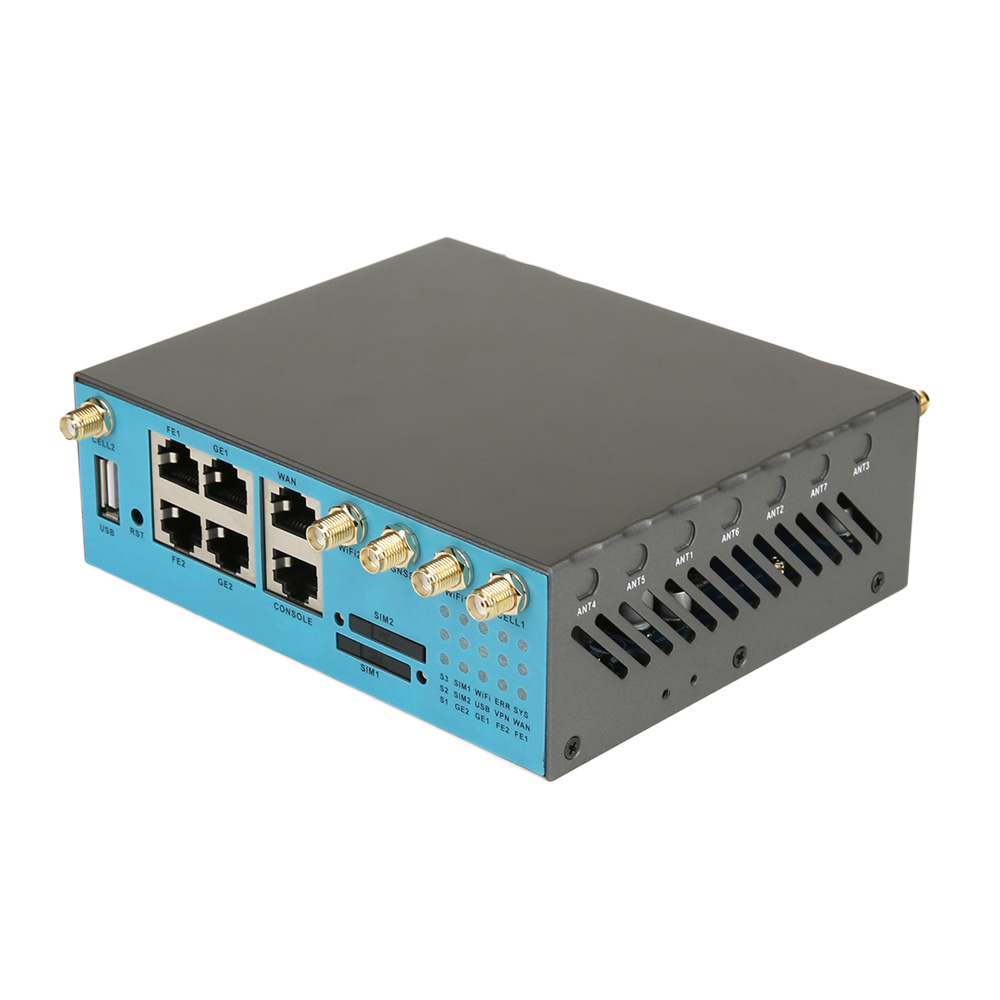
PLCs, meters, and RTUs frequently speak RS232 or RS485, and cabinets often have door contacts or alarm outputs. CPE products are rarely built with these interfaces. Industrial routers such as the E-Lins H900f offer a serial port and four digital inputs and outputs alongside Ethernet.
3. Where does the best signal sit relative to the equipment?
When the strongest signal is on a roof or pole, and the equipment is deep inside a building, an outdoor CPE mounted at the signal point is attractive. When the equipment sits in a cabinet with reasonable coverage, a router with external antennas inside the cabinet keeps everything in one place.
4. What power is available?
CPE products tend to expect a mains adapter or PoE from inside the building. Cabinets, vehicles, and solar sites offer DC supplies that dip and surge. E-Lins industrial routers commonly accept 5 to 40V DC, with a 5 to 60V DC option, through dual power inputs with automatic failover, and include protection against transients, reverse polarity, over-current, and over-voltage.
5. Will anyone be there to restart it?
A device in an occupied office can be restarted by a member of staff. A device on an unattended pumping station cannot. Industrial routers build in hardware watchdog timers and link self-healing so they recover without a visit.
6. Must the site stay connected through an operator outage?
If yes, look for dual SIM. Both families can offer it: the E-Lins H820QOf outdoor 5G CPE is available with single or dual SIM, while the H900f industrial router adds dual SIM hot backup with switchover in seconds, and the H900f IoT 5G modem lists failover across cellular, wired WAN, and Wi-Fi client links.
7. How will traffic reach the head office securely?
Industrial routers are built around VPN and firewall functions; E-Lins routers support WireGuard, IPsec, and OpenVPN, with L2TP, GRE, and DMVPN listed across the range. If a CPE is chosen, confirm the VPN options of that exact model, or terminate the VPN on a separate device behind it.
8. How long must it run, and how will it be managed?
For a one-year construction office, simplicity may matter most. For a ten-year infrastructure asset, remote management through TR-069, SNMP, and a central platform, plus long-term firmware maintenance, matters far more.
Question
Answer pointing to a 5G CPE
Answer pointing to an industrial router
Main users
People and laptops
Machines and controllers
Interfaces
Ethernet and Wi-Fi only
Serial, digital I/O, PoE, GPS
Signal location
Far from equipment, outdoors
Reasonable at the cabinet
Power
Mains or PoE from building
DC supply, vehicle, solar
Staff on site
Yes
No
Continuity
Best effort acceptable
Must survive operator outage
Security
Internet access for users
VPN to control centre
Life and management
Short-term, simple
Long-term, fleet-managed
When the Answer Is Both
Some sites score on both sides. A rural depot may need broadband for staff and a secure link for gate controllers and cameras. Two designs work well. In the first, an outdoor CPE at the signal point feeds a site switch, and an industrial router with its own SIM handles the equipment network and acts as backup. In the second, an industrial router with Wi-Fi and enough Ethernet ports serves both groups, separated by firewall rules. The first gives the best signal; the second gives the simplest management. Neither is wrong, as long as the choice is deliberate.
Four Sites, Four Decisions
An office annex waiting for fibre
Twenty staff, laptops and a printer, no field equipment, mains power and a strong 5G signal on the roof. Every answer points to a CPE. An outdoor unit such as the E-Lins H820QOf on the roof, or an indoor CPE such as the CQ100 if indoor signal is adequate, delivers broadband quickly.
A camera and sensor pole on a ring road
Two HD cameras, an environmental sensor on a serial link, a cabinet door contact, a DC supply, and no staff. Machines, serial, digital input, unattended: an industrial router such as the H900f, which provides serial, four DI/DO and PoE In and Out, is the better fit.
A pumping station cabinet
A PLC on Ethernet, a flow meter on RS232, solar and battery power, and a SCADA master polling over VPN. This is an industrial router site. For moderate data on a standalone 5G network, a RedCap router such as the H685frc or H820frc keeps cost and power lower than full 5G.
A service van
Technicians need Wi-Fi on the move, while the vehicle’s telematics unit needs a reliable link and GPS. Vehicle power and constant movement point to an industrial router. For a 4G fleet, the H900t adds GPS/BeiDou, ISO 7637-2 compliance, and ignition sensing; for staff working away from the van, a 5G MiFi such as the MN20 can supplement it.
Common Misreadings
“5G is 5G, so any box will do.” The radio may be similar; the interfaces, power design, and recovery mechanisms are not.
“An industrial router is overkill for a small site.” Small sites are often the most remote, and a single wasted trip can outweigh the difference in hardware.
“A CPE cannot be used professionally.” For staff broadband, temporary offices, and backhaul from a strong signal point, a CPE is often the right professional choice.
The E-Lins Range on Both Sides
On the CPE side, E-Lins offers the H820QOf outdoor 5G CPE with 5G SA/NSA, 4G fallback, two Gigabit Ethernet ports, and Wi-Fi 5 or Wi-Fi 6; indoor 5G CPE models including the MQ50, CQ100, and MN40; and portable 5G MiFi devices. For 4G outdoor sites, the H820QOt adds an IP68 enclosure, built-in 14dBi antennas, and an IEEE 802.3af/at PoE-powered device input.
On the router side, the H900f flagship combines 5G SA/NSA, three Gigabit and two Fast Ethernet ports, serial, four DI/DO, dual SIM, Wi-Fi 5 or Wi-Fi 6 and PoE In and Out; the mini H685f brings 5G into compact cabinets; and RedCap models such as the H685frc, H900frc and H820frc cover moderate-data sites. All E-Lins industrial routers share components rated from -35°C to +75°C, 15KV ESD protection, 1.5KV electromagnetic isolation, firmware developed in-house with lifetime free upgrades, and management through the E-Lins NMS cloud platform.
The Manufacturer
Shenzhen E-Lins Technology Co., Ltd. has worked in wireless communication since its industrial roots in 1999, released 5G NR industrial routers from 2019, and serves customers in more than 150 countries and regions, with 7×24 remote technical support. Answer the eight questions for each site type before choosing between a 5G CPE and an industrial router, and the right box will usually be obvious.
https://e-lins.com/
Shenzhen E-Lins Technology Co., Ltd. -
AuthorPosts

- You must be logged in to reply to this topic.