- This topic is empty.
-
AuthorPosts
-
01/08/2026 at 13:56 #6013
Five key dimensions for controlling the discharge fineness of bead mills by Rucca
1. Choose the right grinding structure: Energy density determines the upper limit of fineness
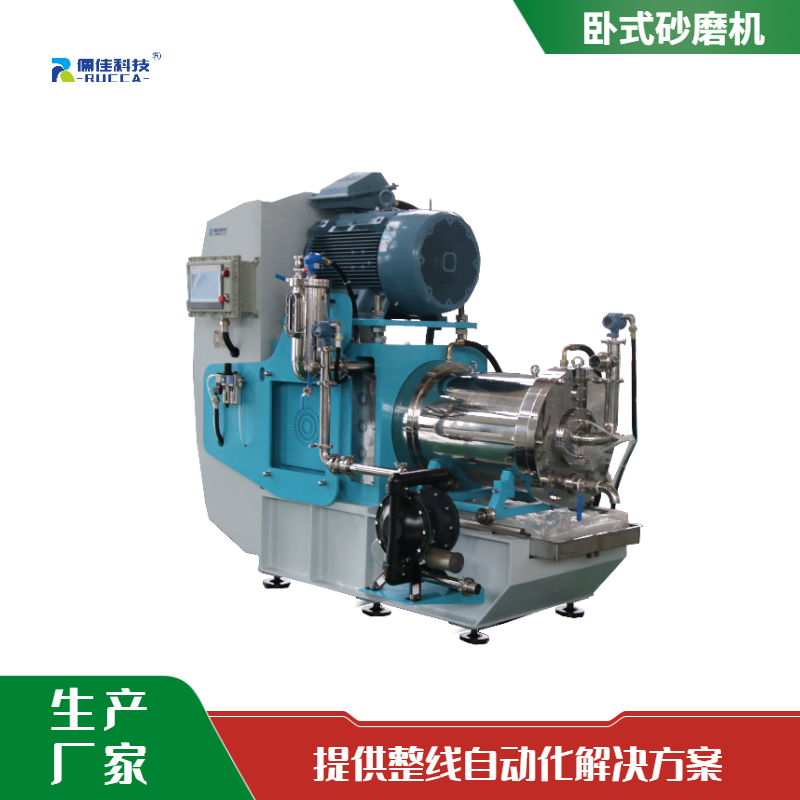
The grinding chamber structure of a bead mill directly determines the energy intensity that can be applied to the material. Rucca's main models adopt the **N series bead mill with a high energy density structure**, which, compared to traditional disc bead mills:
– **Higher energy density**: The rod pin produces more intense and uniform shear and impact forces within the grinding chamber, effectively crushing finer particles
– **More uniform grinding**: The motion trajectory of the grinding medium within the chamber is more complex, ensuring more thorough contact between the material and the medium, eliminating grinding dead zones
– **Adaptation to ultra-fine media**: The rod-pin structure can accommodate ultra-fine grinding beads above 0.03mm, which is the foundation for achieving nanoscale grinding
II. Properly prepare the grinding media: bead size and filling amount are key
The diameter and filling amount of grinding media (zirconia beads) are the core process parameters that affect the fineness:
– **Smaller beads, finer grinding**: The smaller the diameter of the medium, the more contact points between particles, resulting in a finer grinding effect. To achieve stable grinding down to the nanoscale, it is necessary to use ultra-fine beads with a diameter of less than 0.1mm. However, ultra-fine beads impose extremely high requirements on the discharge separation system of the sand mill, which is why many ordinary sand mills cannot use ultra-fine beads.
– **Filling rate affects energy transfer**: Typically, it ranges from 70% to 85% of the effective volume of the grinding chamber. If the filling rate is too low, there will be less contact between the beads, leading to low grinding efficiency; if it is too high, heat accumulation will be severe, affecting the stability of the material.
**Rucca Advantages**: Our UM series and DUM series have been specially optimized for the medium separation system, eliminating the issue of ultra-fine beads blocking the discharge outlet, ensuring stable operation even with beads as small as 0.05mm or even 0.03mm.
III. Adjust the process parameters: speed, flow rate, and series connection mode
This is the "operational level" of controlling granularity, and it is also the core task of Rucca Engineer when debugging for customers:
**Rotational speed**: The higher the rotational speed, the greater the kinetic energy obtained by the grinding medium, and the stronger the shear and impact force on the material, which is conducive to rapid grinding. However, an excessively high rotational speed can lead to a surge in temperature, which is detrimental to heat-sensitive materials. Rucca equipment has a wide adjustable range of rotational speed, allowing flexible settings based on the characteristics of the material.
**Flow rate/Dwell time**: The longer the material stays in the grinding chamber, the more times it is ground, and the finer its granularity. By adjusting the feed flow rate, the dwell time of the material in the chamber can be controlled. Lower flow rate = Longer dwell time = Finer granularity.
**Tandem Grinding**: This is a mature process widely applied by Rucca in industries such as suspension agents, coatings, and inks. Two or more bead mills are connected in series, with the front one for coarse grinding and the rear one for fine grinding. Each stage has a clear division of labor, ensuring both fineness and production capacity.
Customer's actual test data is as follows:
– Yancheng Limin Agrochemical: Two DF100 units are connected in series, ensuring stable discharge of suspension agent with particle size below 5 microns
– An ink company: IDS pre-dispersion + 2 bead mills in series, only 3 grinding passes, and the fineness meets the standard
4. Control the temperature: unstable temperature will affect the control of fineness and whiteness
During the grinding process, mechanical energy is converted into thermal energy, and excessively high temperature can lead to a series of problems:
– Changes in material viscosity affect the motion state of grinding media
– Degradation of heat-sensitive materials (such as certain active ingredients in pesticides)
– Accelerated aging of equipment seals
Rucca's temperature control solution:
**Dual cooling systems, both internal and external**: Both the outer wall of the grinding chamber and the inner rotor are equipped with cooling channels, ensuring a large heat exchange area and high thermal conductivity efficiency
**Fully controllable temperature**: Based on actual measurement data from the Yancheng Limin DF100 production line, the grinding temperature is controlled within 28 degrees Celsius throughout the entire process
**Long-term operation without loss of control**: Even with continuous operation, the temperature can be stabilized within the set range, ensuring consistency in fineness between batches
5、 Do a good job of pre dispersion: the effort before grinding determines the result after grinding
This is a link that many users may easily overlook, but it has a significant impact on the fineness. Before feeding into the bead mill, if the material is not fully pre dispersed, there will be a large amount of aggregates, and the bead mill needs to consume a lot of energy and time to "depolymerize", which greatly reduces the grinding efficiency.
Rucca's Strategy: Pairing with IDS Inline Dispersing System
Vacuum powder suction, instant wetting, eliminate "fish eyes" and secondary agglomeration from the source
The slurry produced by IDS is already uniform and fine, which is equivalent to completing the "initial processing" before entering the sand mill
The number of grinding passes in the later stage sand mill can be reduced by 30% -50%, energy consumption is significantly reduced, and the fineness is easier to meet the standard
A certain ink company tested that with IDS pre dispersion and 2 sand mills connected in series, only 3 passes of grinding are needed to meet the requirements for fineness. If there is no IDS pre dispersion, achieving the same fineness may require 5-6 or even more passes.
Rucca does not rely on a single parameter to "adjust" the fineness, but through the systematic coordination of equipment structure, medium selection, process parameters, temperature control, and pre dispersion, the fineness is stabilized and meets the standard, and the batch consistency is good. This is the correct way for sand mills to control the fineness of the discharged material.
http://www.ruccagroup.net
rucca group -
AuthorPosts

- You must be logged in to reply to this topic.