- This topic is empty.
-
AuthorPosts
-
12/11/2026 at 17:10 #6890
Choosing the right 3D printing filament is no longer a simple matter of picking a color and a spool size. As printed parts move from "display models" toward functional, real-use components, buyers increasingly ask how to choose modified PLA filament that can meet specific mechanical, electrical, or thermal demands. This guide breaks down the decision process using the product and capability information available from SYNLIFE, a technology company built on synthetic biology and materials engineering that develops high-performance bio-based materials, products, and cross-industry application solutions, with 3D printing filament as one commercial application direction within its broader materials platform.
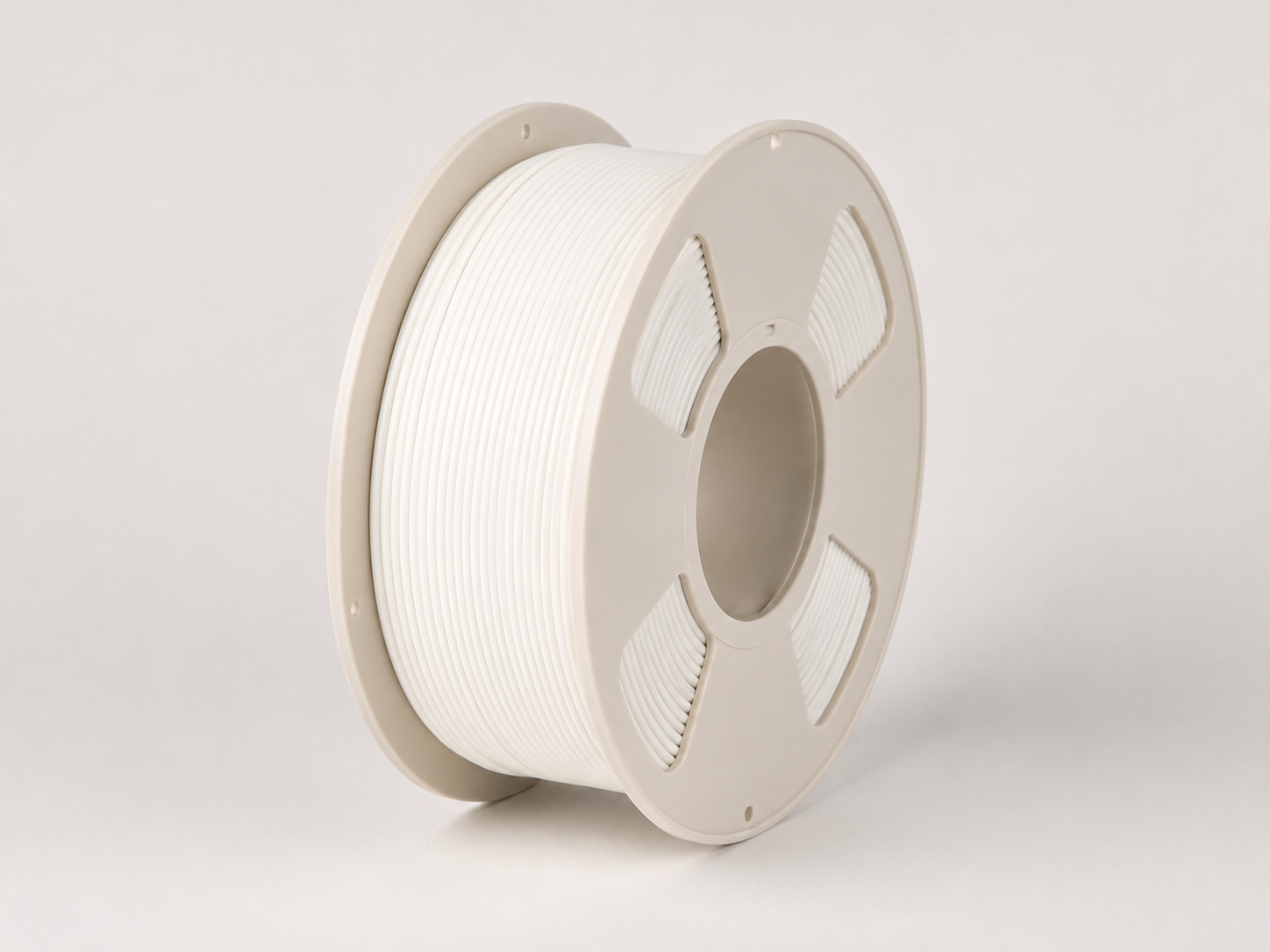
Understanding the Limits of Standard PLA
Standard PLA remains a widely used entry-level material for basic modeling. It is accessible for beginners and well suited to decorative items, figurines, ornaments, and keychains. However, its limitations become apparent once a part needs to do more than look good: standard PLA can be brittle, tends to deform in warm environments, and attracts dust. For buyers whose printed parts are meant only for viewing or light handling, these characteristics may be acceptable. For anyone building functional, load-bearing, or electronics-adjacent components, they usually are not — which is exactly the gap that modified PLA, or PLA+, is designed to close.
What Modified PLA (PLA+) Is Designed to Solve
According to SYNLIFE’s stated industry positioning, PLA filament buyers increasingly require more than basic printability. Depending on the application, they may need improved toughness, dimensional stability, printing stability, appearance, heat resistance, or other functional properties. SYNLIFE develops PLA+ and other modified 3D printing filaments based on its materials engineering and application-development capabilities, with optimization and customization according to specific printing and end-use requirements. In practice, this means modified PLA is not a single formulation but a family of engineered variants, each tuned for a different performance gap left by standard PLA.
SYNLIFE’s Pro Series Functional PLA Line
SYNLIFE’s commercial filament lineup consists of four products: Standard PLA as the baseline, and three members of the Pro Series Functional PLA line — Pro-S, Pro-E, and Pro-T. All three Pro Series products are currently offered in Engineering Black, are optimized for static control, and are designed to upgrade functional printing performance without requiring specialized 3D printers.
Pro-S Functional PLA — Improved Mechanical Performance
Pro-S is a modified PLA filament developed for applications that need improved toughness, durability, or mechanical stability compared with standard PLA. Development work behind this grade focuses on toughness, layer bonding, impact behavior, dimensional stability, and printing performance. It is positioned for fixtures, models, prototypes, functional parts, tooling aids, and other printed components where mechanical performance matters more than appearance alone. Buyers should note that specific mechanical properties and application suitability should be evaluated according to the relevant product grade and test results rather than assumed in advance.Pro-E Functional PLA — Conductive and Sensing Capabilities
Pro-E is built to "bring prints to life" for parts that need to interact with electronics rather than simply house them. Its conductive material matrix allows a printed part to function as a thick resistor or integrated wire, and its resistance changes when bent or pressed, enabling strain, pressure, and touch detection. It also offers better natural antistatic performance, which suits electronic-component trays, antistatic tool trays, and workstation tools. This grade has been used for antistatic tool trays, push-to-light button panels, and educational resistance strips, and its conductive matrix is compatible with standard PLA printing profiles.Pro-T Functional PLA — Heat-Stable and Durable
Pro-T targets parts that sit near heat sources such as motors or routers, where ordinary PLA can warp or lose dimensional accuracy over time. It is designed to maintain shape and structural integrity in warm environments and to resist repeated heating and cooling cycles. Its dimensional stability helps prevent snap-fits from loosening and mounting holes from becoming inaccurate, while its static-control properties help prevent dust buildup inside equipment enclosures. Pro-T has been used for router and modem wall mounts, LED lighting support structures, and motor and fan mounts.How to Match the Right Grade to Your Application
Choosing among these options comes down to identifying the dominant failure mode of the current material in your use case:
- If parts are only for viewing or light handling, Standard PLA is sufficient and remains the easiest grade to print.
- If parts are breaking, cracking, or failing mechanically under normal use, Pro-S’s toughness and dimensional-stability focus is the relevant option.
- If the part needs to sense, conduct, or resist static buildup — for example in electronics prototyping, STEM education, or antistatic tooling — Pro-E addresses that functional requirement directly.
- If parts sit near heat sources or must hold dimensional accuracy over repeated thermal cycles, such as internal equipment structures, mounts, and brackets, Pro-T is the grade aligned with that pain point.
This logic reflects SYNLIFE’s stated industry and customer coverage, which spans desktop and professional FDM/FFF 3D printing, maker spaces, education and STEM, consumer electronics prototyping, functional prototyping, and industrial tooling, serving filament distributors and wholesalers, 3D printing brands, OEM/ODM customers, educational institutions, and both professional and home users.
Printing Setup and Compatibility
A practical advantage of the Pro Series is that it is designed for use with mainstream desktop 3D printers, without requiring specialized hardware. Pro-S is explicitly compatible with a standard 0.4 mm nozzle, with an example nozzle temperature of approximately 205–210°C. Pro-E typically runs at an example nozzle temperature of approximately 210–220°C, with a somewhat slower printing speed recommended for more stable material flow. Pro-T generally requires only minor adjustments from normal PLA settings, with an example nozzle temperature of approximately 200–220°C. In every case, final printing parameters should be optimized according to the specific printer, part geometry, and application rather than applied as a fixed universal setting.
Material Transparency and Realistic Expectations
PLA is a bio-based polymer, but the properties of any finished filament depend on its complete formulation. Standard PLA, Pro-S, Pro-E, and Pro-T should not be assumed to be compostable, biodegradable under all conditions, carbon-negative, or to have a fixed bio-based content unless the specific finished product carries corresponding evidence. Bio-based content, biodegradability, compostability, carbon footprint, and functional performance are separate product attributes and should be evaluated independently when comparing options.
Commercial Availability and Business Model
Standard PLA, Pro-S, Pro-E, and Pro-T are formal commercial products, all currently in stock and available for sale. SYNLIFE supports several delivery models depending on buyer needs, including in-stock finished filament spools, bulk supply, material and formulation customization, OEM/ODM and private-label supply, sample validation, and pilot and scale-up support. This structure allows distributors, 3D printing brands, and institutional buyers to source finished filament directly or to pursue customized formulation development aligned with a specific application.
Conclusion
Selecting a modified PLA filament ultimately comes down to matching a specific functional gap — mechanical weakness, lack of conductivity or sensing, or poor heat stability — to the grade engineered to address it. SYNLIFE’s Pro Series, built on its materials engineering and application-development platform, organizes this choice into three distinct options — Pro-S, Pro-E, and Pro-T — each targeting a different real-world printing limitation while remaining usable on standard desktop equipment.
https://www.synlifeglobal.com/
SYNLIFE -
AuthorPosts

- You must be logged in to reply to this topic.