- This topic is empty.
-
AuthorPosts
-
15/09/2026 at 17:56 #6382
One Question, Two Camps
In March 2018, the IDA(International Dark-Sky Association) Technical Committee released a document that did not attract much attention: the Criteria for Community-Friendly Outdoor Sports Lighting, v1.0. For the first time, it established a quantifiable, certifiable dark-sky compliance framework for sports lighting. It didn’t ban night sports. It drew a line: what level of lighting is “acceptable,” and what is not.
That line matters because it cuts through a long-ignored gray zone — golf course lighting.
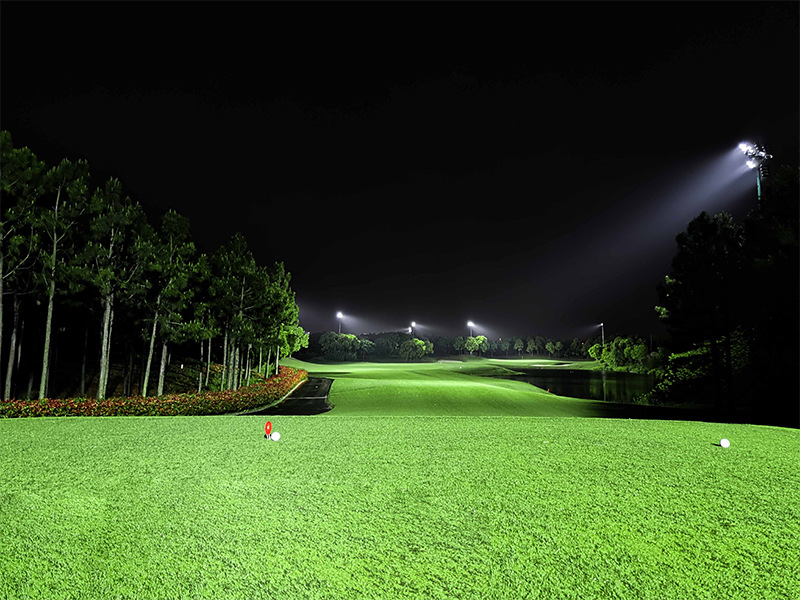
Golf courses are a peculiar case. They occupy large areas, usually far from city centers, but they keep expanding toward suburbs, ecologically sensitive zones, and even the edges of dark sky reserves. Their lighting needs aren‘t concentrated on a rectangular field like a football pitch — they’re distributed along a linear path several kilometers long. Their poles stand 15 to 18 meters tall, fixtures draw hundreds of watts each, and — critically — the ball‘s flight path requires vertical illuminance for visibility. Vertical illuminance is exactly the type of light that is hardest to control for light pollution purposes.
So when the IDA began taking sports lighting’s light pollution problem seriously, golf courses quickly became a flashpoint. Supporters said: night golf is a real sporting need, not a “frivolous concept.” Opponents said: installing dozens of high-mast poles next to an ecologically sensitive area cannot be “dark sky friendly” no matter how you design it.
That debate is far from over. But the IDA criteria provide a technical framework for the conversation — shifting it from “should we do this?” to “what would compliant look like?”
What the IDA Standard Actually Requires: BUG Rating and Three Hard Metrics
Understanding the IDA outdoor sports lighting standard starts with one concept: the BUG rating.
BUG stands for Back–light, Up–light, and Glare — developed jointly by the IDA and the IES to quantify how much light a fixture “wastes” in unwanted directions. Each dimension is scored from 0 (most stringent optical control) to 5 (least control). For dark-sky compliance, Up–light typically must achieve U0 — meaning zero direct light emitted above the horizontal plane.
The IDA Criteria for Community-Friendly Outdoor Sports Lighting refines this into three hard metrics:
Up–light. All lights must be designed not to emit direct light above the horizon. For sports requiring aerial illumination — such as a golf ball in flight — only 8% of total applied lumen may enter this zone. Even in golf scenarios, the vast majority of light must stay below the horizontal plane.
Back–light. Designed lumen outside the field perimeter plus a 10-meter offset must not exceed 15% of the total. Measured spill illuminance at 45 meters beyond the field edge (or one pole height, whichever is greater) must not exceed the limits for the relevant environmental zone.
Glare. Modeled luminous intensity from any light, at any viewing angle 1.5 meters above grade at 45 meters beyond the field edge, must not exceed 1000 candela.
These numbers look technical, but the logic behind them is simple: light should go where it’s needed, and nowhere else.
One more constraint is easily overlooked: lighting zone eligibility. The IDA only certifies sports facilities located in IES environmental zones E2 through E4 (or CIE E1 through E4, or MLO zones 1 through 3). Projects in E0/E1 — the darkest, most ecologically sensitive zones — are effectively ineligible under the current framework. This is not a technical limitation. It’s a matter of principle: some places simply should not be lit.
Why Golf Courses Are the Hardest Case for Sport Lighting design
A 2026 IDA analysis called sports lighting “the hardest dark sky friendly challenge”. Golf courses amplify that difficulty.
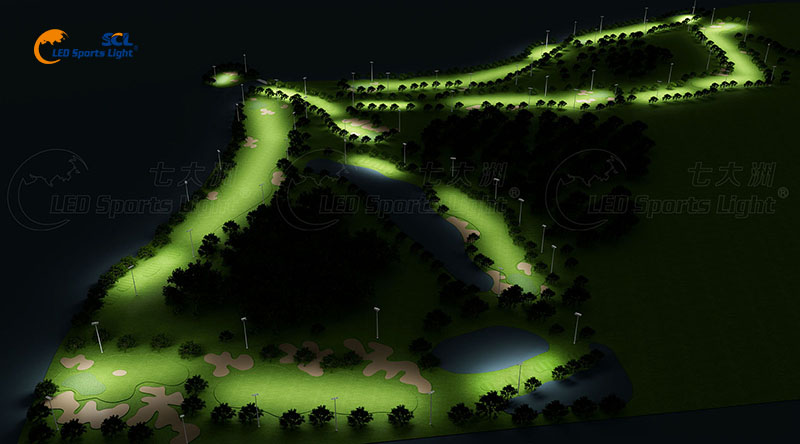
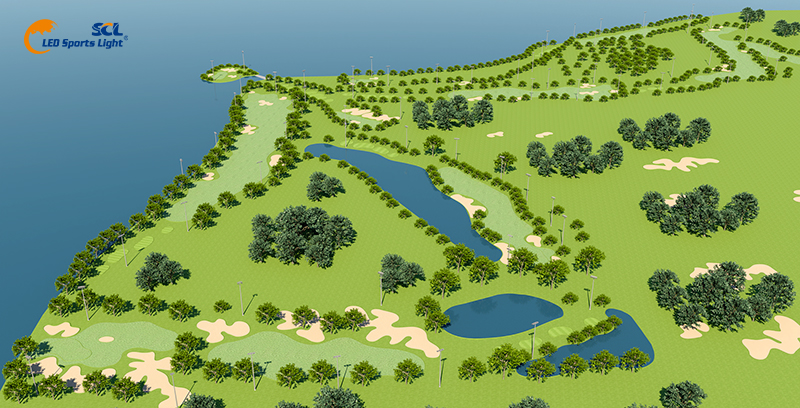
Football field sport lighting is concentrated within a rectangle roughly 100 by 70 meters, with poles along the sidelines, allowing light to be “framed” relatively precisely. A golf course is entirely different: an 18-hole course occupies 50 to 100 hectares, fairways wind along terrain for kilometers, and the ball may fly over 200 meters. Achieving uniform vertical illuminance at that scale while meeting the IDA‘s spill limits requires not just better fixtures but a fundamental rethink of optical design, pole layout, and lighting strategy.
More challenging still: golf courses increasingly sit near ecologically sensitive areas — wetlands, coastlines, nature reserve edges. These are often the exact places where dark sky protection matters most.
In 2024, a renovation plan for Rock Creek Park Golf Course in Washington, D.C., triggered a public controversy. The plan included a high-intensity lighting system to enable night golf. In testimony submitted to the National Capital Planning Commission, Dark Sky DC stated that the proposed system was “categorically ineligible” for Dark Sky certification because the course is located within a highly sensitive ecological zone providing habitat to federally endangered bat species — an area that has been “pitch dark at night since time immemorial”.
In 2026, Waveland Golf Course in Des Moines, Iowa, faced similar resistance. The city planned to light nine holes to extend tee times, but nearby residents worried about light pollution affecting the Drake Municipal Observatory and a bird sanctuary. One resident recalled living near a Topgolf facility: sports-scale lighting “literally ruined the nighttime” — “all you see is just a white hue”. The project was ultimately shelved.
What these cases share: the problem wasn’t technical feasibility. It was site suitability. The IDA‘s lighting zone restrictions mean that in certain ecologically sensitive areas, no fixture is advanced enough to make night lighting appropriate. This raises a question beyond lighting design: should “dark sky compatibility” be a hard criterion in site selection, not an afterthought?
Salt Bay’s Answer: Lighting 18 Holes Next to a Wetland
But not every golf lighting project near an ecologically sensitive area is doomed. Salt Bay Golf Course in South Korea tells the opposite story.
Located in Siheung, adjacent to a wetland preserve, Salt Bay faced a choice when its original metal halide system reached the end of its warranty: replace it with LED sports lighting technology that would improve visibility while reducing energy costs, without disturbing the wetland.
The project team retained 121 existing poles and crossarms and replaced only the 605 luminaires and electrical components. The key was optical design: patented light control technology virtually eliminated glare and spill into the wetland. The result: 53% energy reduction, zero maintenance costs through 2034, and a course operating nightly without measurable light disturbance to the preserve.
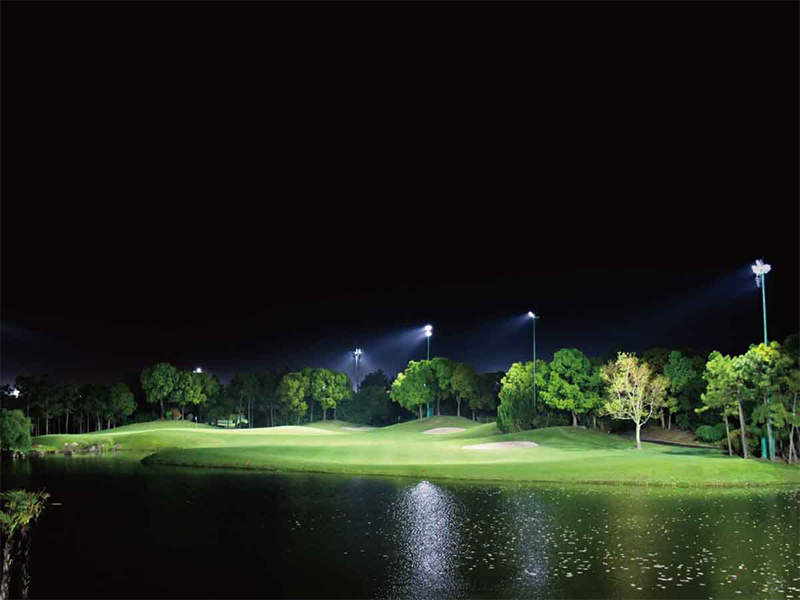
Salt Bay‘s value isn’t the complexity of its technology. It‘s the proof that the IDA standard’s core logic is achievable in a golf context: not less lighting, but precisely controlled lighting. All 18 holes are lit, but the light stays inside the fairway — not a drop escapes.
In Europe, similar progress is underway. In 2026, the Kall-Sötenich sports facility in Germany became Europe‘s first Dark Sky Approved outdoor sports lighting project. Located near Eifel National Park — one of Germany’s designated dark sky reserves — the installation “fully illuminates a competitive football pitch while leaving the sky above it essentially undisturbed”. In Wales, Ruthin‘s rugby club, tennis center, and golf driving range completed dark sky friendly retrofits, with fixtures equipped with cowls that cut off stray light within the playing area.
Beyond the Standard: What Technology Can and Cannot Do
The IDA standard provides a verifiable technical framework, but dark-sky compliance for golf lighting cannot be solved by fixtures alone. Three practical constraints deserve serious attention from anyone planning a course lighting project.
First, site selection sets the ceiling. Courses in E0/E1 zones cannot achieve IDA certification under the current framework. This isn’t something technology can work around. If a course is already located in a sensitive area, the range of viable lighting options narrows dramatically — lower illuminance levels, shorter operating hours, or no lighting at all in certain areas may be necessary.
Second, community relations are a variable. The Wave–land case shows that even when a technical solution meets the standard, residents‘ perceptions and concerns can determine whether a project moves forward. Light pollution is an intensely NIMBY-prone environmental issue — unlike noise, it cannot be blocked by walls; unlike traffic, it cannot be rerouted. Light crosses fences and enters bedroom windows. Community engagement needs to be part of the design process, not an afterthought.
Third, operational strategy matters as much as design. A system that meets IDA standards can still produce light pollution if operated without discipline. Salt Bay’s practice of turning off lights behind players as they progress extends zoning from design into operations. In Des Moines, opponents did not reject night golf outright — they worried about “all-night, full-power” operation. Smart control systems allow courses to adjust dynamically based on actual use: lighting only holes in play, dimming non-core areas during off-peak hours. This isn’t just energy saving. It‘s a practical dark sky protection measure.
A Consensus in Formation
Globally, the relationship between golf course lighting and dark sky protection is shifting from “opposition” toward “conditional coexistence.”
The IDA standard sets a technical baseline: uplight no more than 8%, spill illuminance at 45 meters beyond the field within zone limits, glare intensity no more than 1000 candela. BUG rating U0 has become the entry threshold for dark-sky compliant fixtures. These metrics are measurable and verifiable — not vague “minimize as much as possible” principles.
But beyond the standard, the real challenge is judgment. Judging whether a course should be lit at all — and if so, to what degree. If it already exists, how to minimize impact through optical design, operational strategy, and community engagement. Salt Bay and Kall-Sötenich show that under the right conditions, an 18-hole course can operate nightly without disturbing a wetland or dark sky reserve. Rock Creek Park and Wave–land show that in some places, the most responsible lighting decision may be no lighting at all.
SCL Sports Lighting (Guangdong Seven Continents Industrial Co., Ltd.) has 18 years of experience in sports lighting. Its golf course solutions emphasize “zero spill” optical design, using anti-glare lenses and multi-angle light distribution to direct light precisely onto fairways and greens while reducing spill into surrounding environments. Its intelligent control system supports per-fairway zoning and dimming, providing a technical foundation for dark sky friendly operations. This practice aligns with the core logic of the IDA standard: the value of light isn’t in how bright it is, but in whether it lands where it should.
Final Thoughts
Dark sky compliance for golf course sport lighting is fundamentally a question of boundaries. The boundary of light. The boundary of ecology. The boundary of community. The boundary of sport. The IDA standard gives these boundaries a technical expression — up–light no more than 8%, spill within zone limits, glare no more than 1000 candela. But what ultimately determines a project‘s success isn’t these numbers. It‘s whether the planner is willing to take these boundaries seriously at the earliest stage — rather than waiting until the fixtures are installed and the neighbors start complaining.
Thirty years ago, the core question in golf course lighting was simple: Is it bright enough? Today, the core question has become more complex and more meaningful: Is it bright enough — and “quiet “enough?
https://www.stadiumlight.com/
GUANGDONG SEVEN CONTINENTS INDUSTRIAL CO., LTD -
AuthorPosts

- You must be logged in to reply to this topic.