- This topic is empty.
-
AuthorPosts
-
09/11/2026 at 17:18 #6860
When manufacturers and researchers ask "which major is servo vacuum hot press used for," the answer is not confined to a single sector. Servo vacuum hot press equipment has become a cross-industry solution for precision bonding and lamination wherever multilayer materials must be joined without trapped air, uneven pressure, or thermal damage. Guangdong Taihe Machinery Equipment Co., Ltd., operating under the Taihe brand, supplies this category of equipment and offers a useful reference point for understanding where and why this technology is applied.
What Industries Use Servo Vacuum Hot Press Technology
Based on documented industry adaptation, servo vacuum hot press systems are applied across a wide span of materials and research contexts, including glass, silicon wafers, semiconductor wafer die, sapphire, quartz, batteries, new materials, composite panels, wood, phenolic resin, metallurgical powder, and new energy products. Beyond manufacturing, the equipment also supports laboratory research, medical process research, new materials research, lithium battery research, and hydrogen fuel cell MEA (membrane electrode assembly) lamination.
This breadth reflects the underlying customer base: industrial machinery equipment companies that integrate the press into production lines, and research laboratories that require precise, repeatable bonding for experimental and development work. One documented example is Central Plains Graphene Laboratory, which specified equipment procurement in a technical specification dated August 24, 2026, selecting a 10T Servo Vacuum Hot Press (Electric Cylinder Type), Model TH05DX-RZ-10T, for its research scenario.
Why Vacuum-Assisted Lamination Matters
The core engineering challenge in multilayer bonding is air entrapment. In hydrogen fuel cell MEA lamination specifically, air trapped between multilayer films forms bubbles under heat and pressure. These bubbles cause higher internal resistance, performance attenuation, and shorter service life. Precision material bonding in this context requires simultaneous control of temperature, pressure, holding time, and vacuum to prevent delamination and interface defects.
Vacuum-assisted lamination addresses this by removing interlayer air before pressing begins, which reduces bubble-related defects across applications—not only in fuel cells but in any multilayer bonding scenario where trapped air can compromise contact resistance or structural integrity.
Servo Control as the Foundation of Repeatability
Alongside vacuum capability, servo drive with full closed-loop control provides pressure, speed, position, and thrust control. This matters because inconsistent pressure or displacement reduces interface contact and repeatability—a recurring pain point in precision bonding work. Independent upper and lower heating control and vacuum control further support process flexibility, allowing operators to tailor thermal and vacuum conditions to specific material requirements rather than relying on a single fixed setting.
Two Equipment Platforms for Different Process Needs
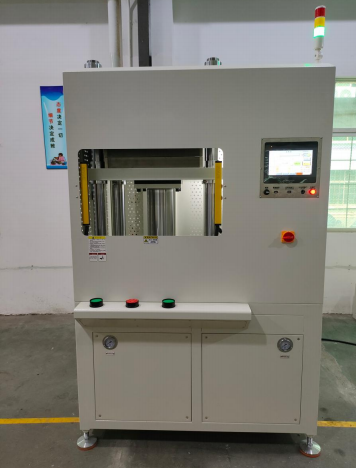
Taihe’s product line consists of two Servo Vacuum Hot Press variants, each built on a three-plate four-column structure with PLC and touchscreen HMI control.
The Servo Vacuum Hot Press (Hydraulic Type) uses hydraulic servo closed-loop control, delivering 1%F.S system pressure accuracy and +/-0.02mm displacement repeatability. Its PID-controlled IR heating system maintains temperature control accuracy at +/-1°C across a room-temperature-to-500°C range. The hydraulic system operates at a maximum of 20MPa, with servo clamping and mold opening speeds of 80mm/s, and servo detection/pressing/buffering speeds ranging from 0.5 to 20mm/s.
The Servo Vacuum Hot Press (Electric Cylinder Type) relies on a full closed-loop electric cylinder system with no heat release during operation, realizing speed, position, and thrust control. It achieves finer precision, with 0.1%F.S system pressure accuracy, +/-0.008mm displacement repeatability, and temperature control accuracy of +/-0.5°C. Its vacuum degree reaches -101.2kPa, and servo detection/pressing/buffering speeds range from 0.001 to 20mm/s, suited to applications demanding tighter tolerances.
Both platforms share common engineering foundations: Cr15 guide columns with high-frequency vacuum quenching, precision grinding, and hard chrome plating; imported special hot-work die steel heating plates with multi-point temperature sensing and PID control; and safety systems including light curtains, mechanical and electrical limits, and emergency stop functions.
Data Traceability and Process Management
A recurring pain point noted across use cases is that manual recipe management slows production when processes change frequently. To address this, both press types support up to 100 process recipes, with the ability to increase quantity per requirements, allowing operators to set, save, query, and recall parameters rather than re-entering them manually each run.
The system capacity extends to 200,000+ groups of pressing data, collected at a data extraction frequency of 300Hz/s. Collected data includes date, serial number, shift, operator information, product name, pressing pressure, pressing position, and pressing result. This data can be displayed as a real-time pressure-time curve on the HMI, then stored, queried, exported, printed, or captured as curve images for product analysis and process improvement. EXCEL report export via USB flash drive supports further offline analysis, archiving, and quality traceability.
Safety and Operational Reliability
Precision bonding equipment must also manage operational risk. Both platforms include overload and short-circuit protection switches, buzzer alarms when temperature exceeds the upper limit, and audible-visual alarm handling for unqualified pressing data or abnormal operation. Pressure and position interlock alarms trigger when values exceed set limits, and safety light curtains respond to abnormal objects in the detection area by triggering a buzzer alarm and returning the servo to origin or stopping it, depending on configuration.
Service and Deployment Support
Deployment follows a custom equipment supply model that includes on-site installation, commissioning, training, and after-sales support. Service scope covers equipment structure training, automatic and manual operation training, process monitoring, maintenance, troubleshooting, and delivery of technical documentation such as layout drawings, assembly drawings, electrical schematics, operation and maintenance manuals, wear parts lists, and test and acceptance reports.
After-sales assurance includes a 12-month warranty from final acceptance, with quality-related parts replacement handled by the seller, post-repair response within 2 hours, and free technical service for customer-caused improper operation, with consumables charged separately. On-site installation requirements differ slightly by type: the hydraulic model requires three-phase AC480V +/-10%, 50Hz power, while the electric cylinder model requires three-phase AC380V +/-10%, 50Hz, with both requiring ambient temperature from room temperature to 40°C, humidity of 0-90%, and an electric control cabinet installed within 5m of the equipment.
Matching Equipment to Application
For organizations evaluating which servo vacuum hot press configuration fits their process, the decision generally comes down to precision requirements and material sensitivity. The electric cylinder type’s finer displacement repeatability and vacuum degree suit applications demanding tighter tolerances, such as hydrogen fuel cell MEA lamination, semiconductor wafer die bonding, or graphene-related laboratory research like that conducted at Central Plains Graphene Laboratory. The hydraulic type, with its broader temperature range up to 500°C and robust pressure accuracy, fits processes involving heavier-duty materials such as composite panels, wood, or metallurgical powder.
Across both platforms, Guangdong Taihe Machinery Equipment Co., Ltd. positions its Taihe-branded servo vacuum hot press systems as equipment designed to help customers achieve void-reduced bonding, stable process parameters, and traceable production data—criteria that remain central regardless of which specific industry or research application is being served.
wwww.gdthjx.cn
Taihe Machinery -
AuthorPosts

- You must be logged in to reply to this topic.